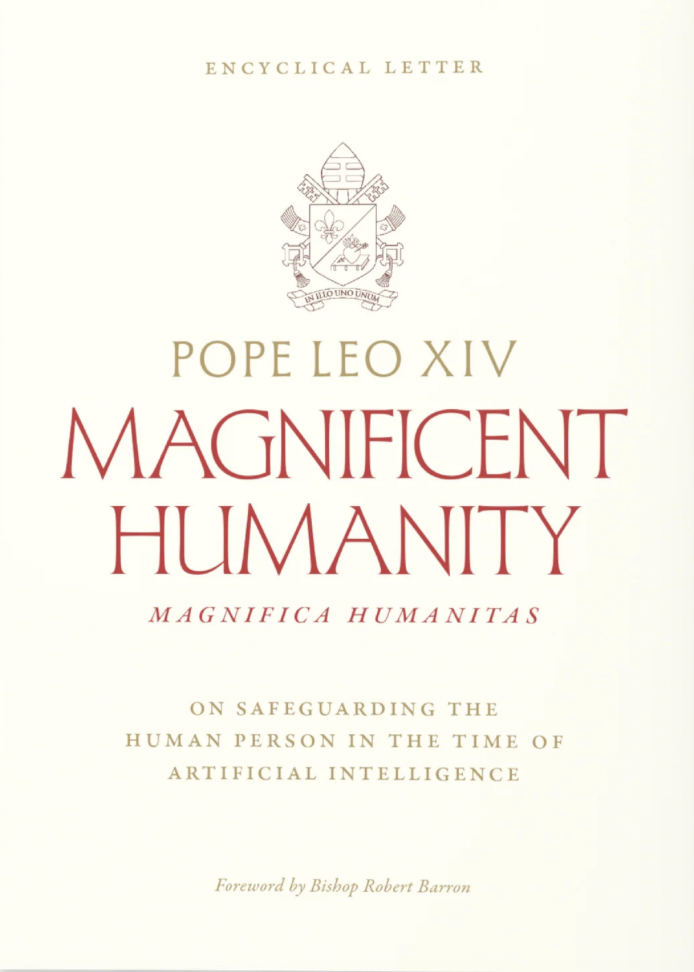
Magnifica Humanitas: On Safeguarding the Human Person in the Time of Artificial Intelligence
by Pope Leo XIV
Virtue scores
Review
Magnifica Humanitas: On Safeguarding the Human Person in the Time of Artificial Intelligence (Word on Fire, 2026) is the first encyclical of Pope Leo XIV — born Robert Francis Prevost, the 267th successor of St. Peter, the first American pope, and the first Augustinian pope in the Church's history. With a foreword by Bishop Robert Barron, this Word on Fire edition presents the papal document in accessible paperback form alongside the Pope's own remarks at its presentation in the Synod Hall on May 25, 2026. The encyclical situates itself explicitly within the tradition of Catholic social teaching inaugurated by Leo XIII's Rerum Novarum (1891), which addressed the upheaval of industrial capitalism. Pope Leo XIV invokes his predecessor directly: "135 years ago, my venerable predecessor Leo XIII observed the situation of factory workers, their families uprooted and new forms of poverty generated by rapid industrial transformation. He understood that the Church could not remain distant."¹ The new encyclical makes the same move for the age of artificial intelligence, which the Pope describes as a "transformation of similar magnitude, with perhaps even greater consequences."² The encyclical's governing framework is biblical: the modern world stands before a choice between the Tower of Babel — technological ambition unmoored from conscience — and the rebuilding of Jerusalem, as in the prophet Nehemiah, who "gathers discouraged people to bring about rebirth" from the ruins.³ Against AI deployed as an instrument of "domination, exclusion and death," Leo XIV calls for what he terms the "disarming" of artificial intelligence — deliberately provocative language he defends as necessary "to attract attention, awaken consciences and indicate paths forward."⁴ The encyclical is structured across five chapters moving from the foundations of Catholic social doctrine, through the theological anthropology of human dignity, to the concrete threats posed by autonomous weapons, biased algorithms, and digital exclusion, and finally to the vision of what Leo calls "the civilization of love." That concluding vision draws on Paul VI and John Paul II to insist that authentic development concerns "each man and the whole man" — a formula Leo uses to reject both the exclusion of any person from the benefits of digital transformation and the reduction of any person to data, productivity, or cognitive performance.⁵ The encyclical's closing note is one of tempered hope: "In the humble fidelity of daily life, even the era of AI can become a time in which the Holy Spirit brings about the civilization of love in our lives."⁶ Endnotes Pope Leo XIV, Address at the Presentation and Promulgation of Magnifica Humanitas, Synod Hall, May 25, 2026, Vatican website, vatican.va/content/leo-xiv/en/speeches/2026/may/documents/20260525-presentazione-enciclica.html. Leo XIV, Address, May 25, 2026. Leo XIV, Address, May 25, 2026. Leo XIV, Address, May 25, 2026. Leo XIV, Address, May 25, 2026, citing Paul VI. Pope Leo XIV, Magnifica Humanitas: On Safeguarding the Human Person in the Time of Artificial Intelligence (Elk Grove Village, IL: Word on Fire, 2026), quoted on the Word on Fire product page, bookstore.wordonfire.org/products/magnifica-humanitas.
✓ Strengths
- ✓The title itself, 'Magnifica Humanitas,' positions the work squarely within the Created state of the CCMMP: human greatness is not an achievement but a given, rooted in the act of creation itself, which offers a counter to reductive anthropologies in both secular psychology and therapeutic culture.
- ✓Word on Fire's editorial orientation toward intellectual rigor combined with pastoral accessibility suggests the book addresses both the mind and the will, engaging readers who want to understand why Christian humanism differs from secular humanism rather than simply asserting that it does.