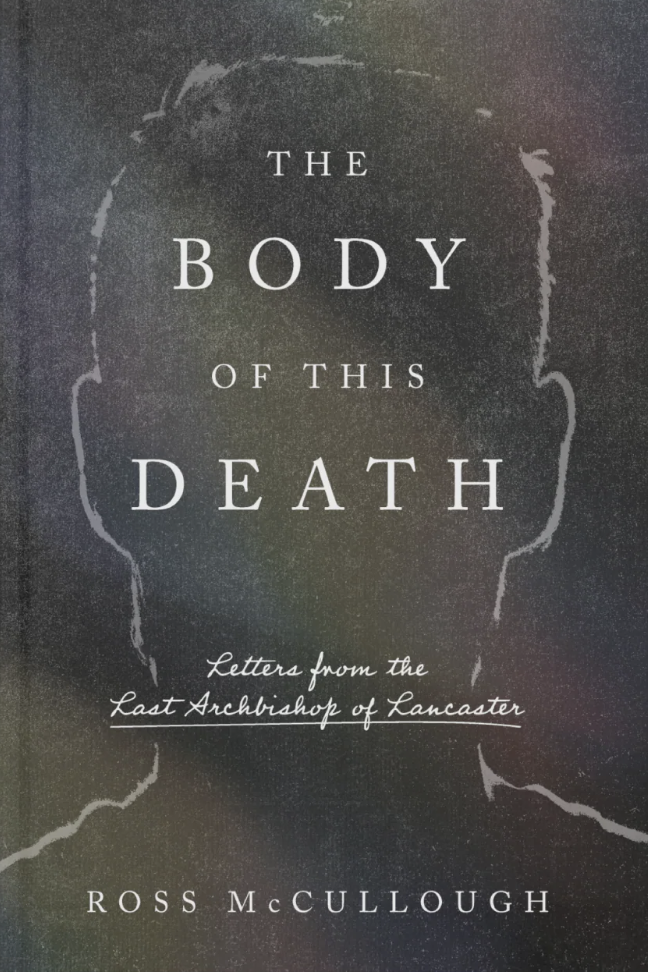
The Body of This Death: Letters from the Last Archbishop of Lancaster
by Ross McCullough
Virtue scores
Review
The Body of This Death (Word on Fire Academic, 2025) is a work of literary fiction structured entirely as an epistolary novel — a collection of letters written by a Catholic archbishop awaiting execution in a dystopian, technology-saturated future. The book is framed by a scholarly apparatus: a fictional editor, Vincent Hermès, presents the letters as a manuscript he received from a friend in the diocesan archives of Buenos Aires, a handwritten copy of correspondence that had already begun to generate its own critical literature. This layered, arch construction — the editor's footnotes, competing scholarly interpretations, even unresolved questions of authorship — is not merely ornamental. It signals from the first page that the novel is concerned with the nature of transmission, interpretation, and the fragility of truth across time. The Archbishop's world is one in which "immersive reality" (IR) has largely displaced embodied life. Consciousness-transfer technology promises to free humans from their bodies; sacramental life is under pressure from a culture the Archbishop calls "metamodern" — "whatever bastard elopement of Islam and spiritualism and liberalism we have now, whatever tangle of heresy with heresy with heresy our metamodernity is."¹ Against this ambient dissolution, the Archbishop argues relentlessly for the irreducibility of the body. When a correspondent raises the possibility of celebrating confession through immersive reality, the Archbishop rejects it: "You cannot absolve a physical person in immersive reality . . . confession in IR would be too easy; it would lack the discomfort of telling your sins in the physical presence of another person — in the physical presence of the Lord, since the confessor stands in persona Christi."² Similarly, he condemns the aspiration to upload consciousness to a digital substrate as "a profanation of the temple," analogizing it to relocating the memorial at Auschwitz: "we do not move it to some better-funded location and pretend it is the same."³ The letters are addressed to a small, carefully varied cast: Barlow, a Catholic layman and old friend; Sr. Perpetua, a nun; Fr. Rodrigues, a somewhat refractory priest in the Archdiocese; Ms. Bushra, a lapsed Muslim; and Mr. Payne, a non-religious correspondent drawn to the Archbishop through personal tragedy. The range of interlocutors allows the novel to move fluidly across registers — tenderness toward a young orphan girl named Felicity whose parents the Archbishop failed to visit in life; spiritual direction for a priest navigating a hostile civic order; theological argument with a Muslim woman about whether religious commitment can be deferred until a child is old enough to "choose" it. The "Posthumous Letters" collected at the end — described in the editorial apparatus as having been "dictated at some later date" after the Archbishop's death — deepen the novel's meditation on time, memory, and hope. The Archbishop meditates in one letter on hope as "the most temporal of the theological virtues": "In faith and love we look to the author of the story, with confidence that he will make things right; in hope we look forward to the act by which he does make it right . . . If the past is a foreign country, hope is what makes it a mission field."⁴ The novel's epigraphs — drawn from St. Ephrem the Syrian, St. John of Damascus, Kierkegaard, and the fictional "St. Eclat" — signal its sensibility: image-saturated, paradox-loving, suspicious of system. The editor's note observes that the Archbishop "relies very little on the clarity and systematicity of thinkers he would have been familiar with from his seminary education, like Aristotle and Aquinas, and inclines instead to the Desert Fathers, Pascal, T.S. Eliot, and the like."⁵ The result is a novel that reads less like an argument than a labyrinth — which is precisely the Archbishop's preferred image for the modern world and, it turns out, for his own mind. Endnotes Ross McCullough, The Body of This Death: Letters from the Last Archbishop of Lancaster (Word on Fire Academic, 2025), Letter to Fr. Rodrigues, preview PDF. McCullough, The Body of This Death, Letter to Fr. Rodrigues. McCullough, The Body of This Death, Letter to Fr. Rodrigues. McCullough, The Body of This Death, Letter to Barlow. McCullough, The Body of This Death, "Note to the Reader" (Vincent Hermès, editor).
✓ Strengths
- ✓Takes the body's mortality with full theological seriousness, refusing to spiritualize death into a mere transition — the incarnational weight of physical dying is treated as the proper site of redemption, not an embarrassment to be minimized.
- ✓Published by Word on Fire, the book situates Christian hope squarely within the Paschal Mystery: death is not the final word, but neither is it bypassed — the Redeemed state is entered through, not around, the Fallen condition.
- ✓The title itself — drawn from Romans 7:24, Paul's cry 'Who will deliver me from the body of this death?' — anchors the work in Scripture and locates the anthropological problem precisely: the disordered body as the site of both suffering and potential transformation.
- ✓Engages the perennial question of what it means to be human in a mortal body without collapsing into either Gnostic body-denial or secular materialism, holding the Created dignity of embodied personhood alongside its Fallen fragility.
- ✓The Word on Fire imprint signals a catechetical seriousness suited to adult formation, RCIA contexts, and Catholic grief ministry, where readers need more than consolation and less than academic theology.
⚠ Considerations
- ⚠Some crass language.