Virtue scores
Review
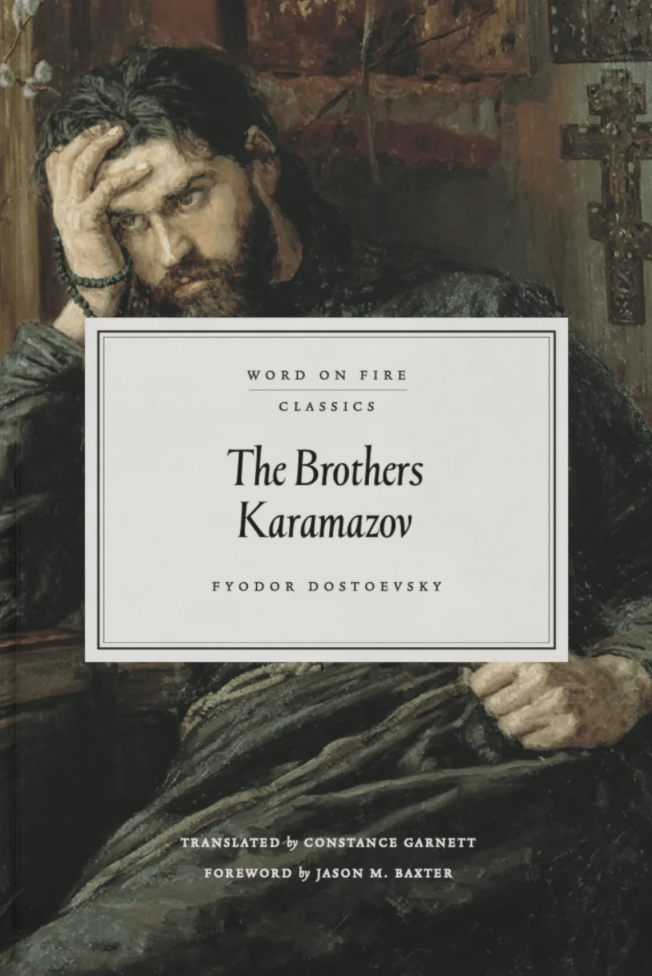
SECTION ONE Fyodor Dostoevsky finished The Brothers Karamazov in 1880, one year before his death, and the novel reads as a life's final reckoning. The story centers on the Karamazov family — the dissolute patriarch Fyodor Pavlovich and his three sons, Dmitri, Ivan, and Alyosha — whose rivalry over an inheritance and a woman culminates in patricide and a criminal trial. But the murder plot is a frame. The real subject is the question Ivan poses directly: if God permits the suffering of innocent children, can any theological justification redeem that fact? Dostoevsky does not answer through Ivan. He answers through Alyosha, the youngest brother and a novice monk, whose patient, concrete love for the people around him constitutes the novel's theological argument. The Word on Fire edition makes this argument accessible to readers who want not only the story but a serious encounter with the ideas driving it. This is the novel to give someone who has been told that Christianity cannot survive honest intellectual scrutiny. SECTION TWO - **Created**: Dostoevsky locates human dignity not in abstraction but in the face of each person encountered. Father Zosima's teaching — that every person is responsible to every other person, and that this responsibility flows from each soul's direct relation to God — is the novel's anthropological foundation. This is original goodness understood as relational, not merely individual. - **Fallen**: Ivan Karamazov is the novel's most precise portrait of concupiscence operating at the intellectual level. His rebellion is not ignorance but disordered will: he acknowledges God's existence and refuses him anyway, on moral grounds. Dostoevsky understood, ahead of most psychologists, that the deepest human disorder is not weakness of mind but the refusal of love — what Aquinas calls aversio a Deo enacted in rational argument. - **Fallen**: Dmitri's arc traces the disorder of the passions with equal precision. His jealousy, financial recklessness, and violence are not explained away as illness or circumstance — they are presented as free choices that compound into a character, and they cost him everything. The novel refuses the modern consolation of determinism. - **Redeemed**: The transformation Dostoevsky dramatizes is specifically purgative. Dmitri's false conviction and his decision to accept suffering rather than escape it constitutes the novel's most direct treatment of how suffering, freely accepted, becomes a site of grace. This maps onto what John of the Cross calls the passive purifications of the will: not self-chosen mortification, but the suffering that arrives unbidden and is either received or refused. - **Justice (sacrifice)**: Alyosha's practice of accompaniment throughout the novel — with the dying Ilyusha, with the humiliated Snegiryov, with Ivan in his spiritual crisis — is the novel's enacted answer to Ivan's rebellion. It demonstrates justice not as abstract fairness but as presence with the suffering other at personal cost. SECTION THREE Peterson[^1] cites The Brothers Karamazov directly in Maps of Meaning alongside Notes from Underground and Crime and Punishment as primary literary sources for his account of how myth and narrative carry moral meaning that propositional argument cannot — a reading that complements the novel's method, in which Dostoevsky defeats Ivan's intellectual rebellion not by out-arguing him but by showing Alyosha's love at work. Pierce[^2] similarly draws on Dostoevsky's fiction as a case study in personality structure and the relationship between the shadow and the moral will, placing the Karamazov brothers in dialogue with Jungian typology. Both connections illuminate how the novel functions: its theological anthropology is carried by character and story, not by doctrine, which is precisely what makes it so effective in formation contexts alongside more systematic Catholic sources. ## References 1. Peterson, Jordan B. (1999). *Maps of Meaning: The Architecture of Belief*. Bibliography. — 'Dostoevsky, F. (1981). The brothers Karamazov (A.H. MacAndrew, Trans.). New York: Bantam Books.' 2. Pierce, Michael. *Motes and Beams: A Neo-Jungian Theory of Personality*. Works Cited. — 'The Brothers Karamazov, trans. Constance Garnett, Barnes & Noble Classics (2004)'
✓ Strengths
- ✓Dostoevsky places the question of whether God's existence can justify human suffering at the center of the novel, and his answer — worked out through Alyosha's love and Father Zosima's teaching — is not a philosophical argument but a demonstration of how active love transforms the person who practices it.
- ✓The three Karamazov brothers embody distinct orientations of the human will: Ivan's rational rebellion against suffering, Dmitri's passionate disorder, and Alyosha's movement toward redemption — together forming a complete anatomy of the fallen person and the paths available to him.
- ✓Father Zosima's doctrine of 'active love' as opposed to 'love in dreams' maps directly onto Aquinas's account of charity as an operative habit, not a sentiment — the novel dramatizes this distinction through Alyosha's concrete acts of accompaniment throughout the narrative.
- ✓The Grand Inquisitor chapter is one of the most sustained literary treatments of freedom as a burden: Dostoevsky shows how disordered desire seeks to escape genuine freedom by trading it for bread, miracle, and authority — a precise depiction of what Aquinas calls the will's flight from the arduous good.
- ✓The novel's climactic movement through suffering toward forgiveness — especially in Dmitri's transformation after his arrest — models the purgative dimension of growth: suffering accepted in love reshapes the person rather than destroying him.
⚠ Considerations
- ⚠The novel's philosophical passages, particularly Ivan's rebellion and the Grand Inquisitor's monologue, present atheism and the rejection of divine providence with such intellectual force that readers without a formed philosophical grounding may find them destabilizing rather than clarifying — Dostoevsky's rebuttal is embedded in narrative and character, not argument, and can be missed.
- ⚠Some pastoral readers may expect Alyosha's spiritual growth to follow a more explicitly sacramental arc; the novel's Christianity is deeply Orthodox in sensibility and differs in certain emphases from Catholic ascetical theology, which formators should note when using the text in Catholic formation contexts.