Virtue scores
Review
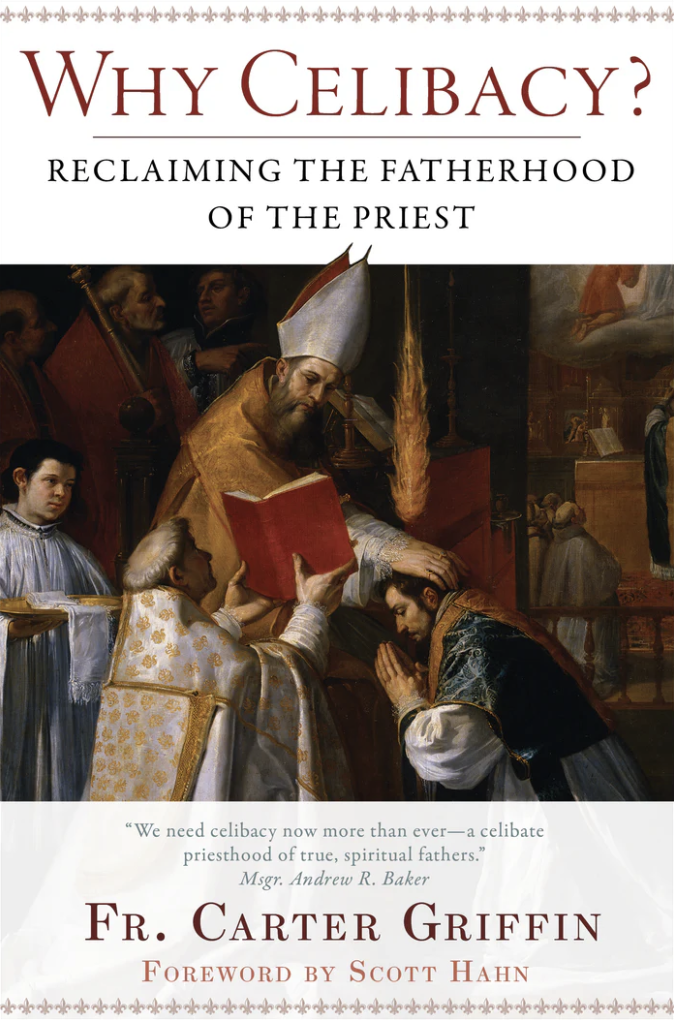
Fr. Carter Griffin | Emmaus Road Publishing, 2019 | 215 pages What does it mean to be a father? The question sounds simple until you press it — and Fr. Carter Griffin, rector of the St. John Paul II Seminary in Washington, D.C., presses it with considerable theological force in Why Celibacy? Reclaiming the Fatherhood of the Priest. His central claim is that celibacy cannot be understood in isolation from fatherhood, because the priesthood itself is irreducibly paternal. Strip away that fatherhood, and celibacy becomes an inexplicable deprivation. Recover it, and celibacy becomes not only intelligible but luminous. Griffin's argument begins at the source. God the Father's eternal generation of the Son is itself a kind of celibate paternity — pure gift, undivided, ordered entirely toward the life of the other. Jesus, the one high priest, was incarnated as a celibate man, and as a celibate man he generated the Church. The priest, configured to Christ the Head through ordination, participates in that same generative love. His celibacy is not an absence but a form — the form of a fatherhood ordered not toward biological offspring but toward eternal life in souls. As Griffin writes, priestly celibacy "when lived well — is a privileged way of embracing a fatherhood that transcends nature alone; it is 'supernatural' fatherhood in the order of grace." This Christological grounding is the book's most important move. It means that when a priest renounces natural marriage, he is not renouncing fatherhood — he is embracing a more radical version of it. The "undivided heart" commended by Vatican II's Presbyterorum Ordinis describes not merely a priest's schedule but his entire interior orientation: a man whose heart has been dilated, not diminished, by celibacy. Griffin points to St. John Vianney as the embodiment of this reality — a priest with no natural family calling him home, whose availability to souls made him one of the great spiritual fathers of the Church's history. This vision of fatherhood also carries a pointed diagnosis of what goes wrong when priests fail to inhabit it. Griffin identifies three malformations particularly common today: narcissism, clericalism, and activism. Each is, at root, a distortion of paternity. The narcissistic priest turns ministry inward, craving admiration and compensating for interior emptiness with material or emotional consolations. The clericalist mistakes the authority of a father for the control of a bureaucrat. The activist measures his priesthood in programs and administration, forgetting that a father's first task is not management but presence — the kind of sanctifying, self-forgetful presence that generates life in others. Griffin's descriptions are sharp without being polemical, and his proposed antidote — genuine spiritual fatherhood, rooted in prayer and authentic friendship — is more constructive than corrective in tone. One of the book's quieter but more important arguments is that priestly fatherhood does not compete with natural fatherhood — it illuminates it. Griffin draws a direct line from the celibate priest's witness to the renewal of fatherhood in the home. Sts. Augustine and Chrysostom called the family the "domestic church," and Augustine once addressed the fathers in his congregation as "my fellow bishops." The priest who lives his celibate paternity faithfully becomes, paradoxically, one of the best teachers of natural fatherhood available to a parish. Married reviewers of this book have noted exactly this: that Griffin's celibate witness has educated them in what it means to lay down their lives for their families. The book is not exhaustive — readers looking for a sustained engagement with competing theological positions will need to look elsewhere. But Griffin is writing as a formator with a constructive purpose, and that purpose is well served by the book's elegant, accessible 215 pages. In a cultural moment defined by the collapse of fatherhood at every level, Why Celibacy? is a quietly countercultural act. It insists that the deepest human longing — to give life, to be known as a father, to generate something that outlasts you — finds its fullest expression not in biology alone but in grace. Fr. Griffin has written a book that is theologically serious, humanly warm, and genuinely necessary. Sources: Filling Heaven with God's Children: Priestly Celibacy and Paternity — Humanum Review Why Spiritual Fatherhood and Celibacy Are a Natural Fit — National Catholic Register Book Notes: "Why Celibacy" — CatholicMom
✓ Strengths
- ✓Griffin reframes priestly celibacy not as renunciation of fatherhood but as its fullest exercise, grounding a potentially abstract discipline in the concrete anthropological category of paternity — spiritual fatherhood as generating, providing for, teaching, and protecting.
- ✓The book engages the live debate over optional celibacy directly, which gives the argument pastoral and ecclesial traction rather than treating celibacy as a settled question requiring only defense.
- ✓Griffin draws on both patristic tradition and contemporary formation practice (he writes as rector of St. John Paul II Seminary), so the argument moves between theological principle and institutional application.
- ✓The framework of spiritual fatherhood connects priestly identity to the broader social science on father absence, which retrieved passages from the canon treat at length — making the book a natural counterpart to psychological research on paternal function.
- ✓Endorsements from seminary rectors, a formation theologian (Keating, Creighton), and George Weigel suggest the book is already in active use in formation contexts, not merely as apologetics.
⚠ Considerations
- ⚠The argument risks assuming that the category of 'spiritual fatherhood' translates cleanly across cultures and ecclesial contexts; readers from Eastern Catholic traditions or mission churches may find the Latin-rite frame underexamined.
- ⚠At 215 pages, the book may not engage the psychological literature on father development with the depth the social science warrants — the retrieved passages suggest that literature is richer and more demanding than a theological text can fully address.